
Robotics engineer · Co-founder, XP Robotics

I build robots that learn to
see, move, and act.

I work across the robotics stack — training vision-language-action policies for manipulation, reinforcement-learning controllers for bipedal walking, and the perception and motion-planning code that has to survive contact with real hardware. Almost everything below either runs on a physical robot today or is on its way there.

  • SmolVLAVLA policies on real arms
  • PPO · RSL-RLbipedal locomotion
  • ROS 2 · Isaac · MuJoCosim & deployment
Aryaman Saraogi
Aryaman Saraogi

01 — About

Aryaman Saraogi

I'm a robotics engineer and one of the founders of XP Robotics. My focus is the software layer of physical robots — vision-language-action policies for manipulation, reinforcement-learning controllers for legged locomotion, and the perception and calibration code in between.

I'm drawn to the problems that only show up once the robot is real: contact, latency, sensor noise, and the gap between a policy that works in simulation and one that survives outside it.

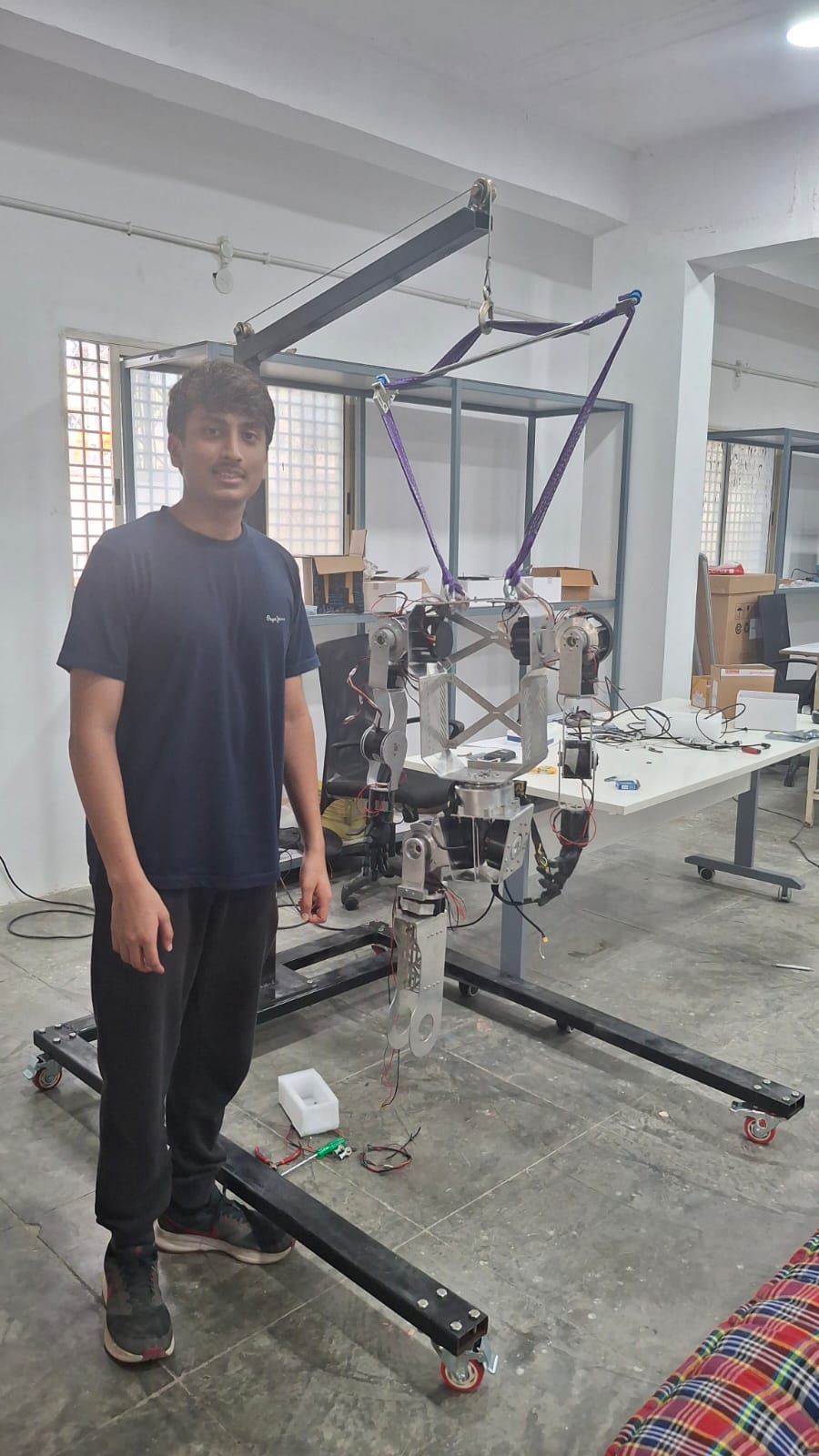
Aryaman next to the 52-DOF humanoid on its test gantry
With the XP Robotics humanoid, mid-build
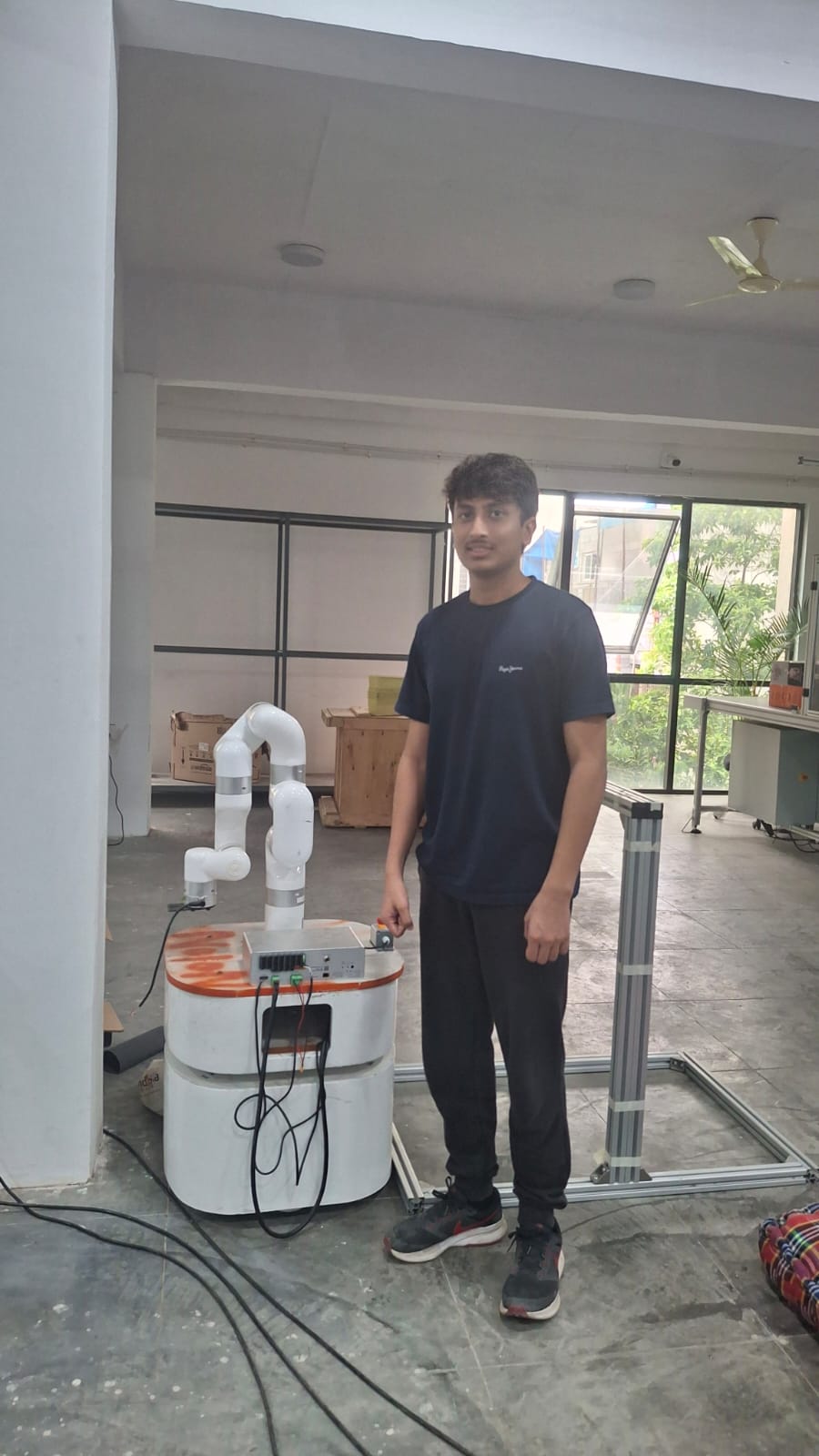
Aryaman next to the UFACTORY xArm 7 mounted on a mobile base
UFACTORY xArm 7 on a mobile base

02 — Selected work

Robotics

Three threads run through all of it: learned manipulation, legged locomotion, and the simulation-and-systems plumbing that connects a policy to a motor.

A Learned manipulation

Industrial pick & place · XP Robotics

Vision-guided carton picking on a HITBOT 6-axis arm

A 6-axis HITBOT arm picks up a carton whose position it was never taught. No fixtures, no hardcoded coordinates, no ROS — the entire stack is Python.

  1. An Intel RealSense D415 captures a single aligned depth frame, deprojected into a point cloud, voxel-downsampled, and fitted for the support plane.
  2. Anything standing a few centimetres above that plane becomes a candidate. DBSCAN clusters the points; each cluster gets an oriented top face and a bounding size.
  3. The planner checks whether the carton's top surface is large enough for the four-pad suction to seal. If it isn't, the arm doesn't move toward it. Of the rest, it takes the nearest.
  4. The pose is transformed through hand-eye calibration into base coordinates. The pick is three Cartesian moves — hover, contact, lift — each run as interpolated waypoints with an IK solution at every step, aborting if the solver flips configuration mid-path.
  5. Descent intentionally overshoots the expected contact by ~13 mm so the suction bellows compress; at 3 mm the pads were only barely touching the lid. Then: vacuum on, dwell, lift, swing the base joint, descend, release, home.

The carton is placed at a PLC-controlled station — the first step toward a real industrial deployment.

  • Python
  • RealSense D415
  • Point-cloud segmentation
  • DBSCAN
  • Hand–eye calibration
  • Cartesian IK
  • 4-pad suction
  • PLC station

Imitation learning · XP Robotics

SmolVLA pick & place on a LeRobot arm

A LeRobot arm autonomously picks a red cube and drops it in a box — from demonstrations alone, with no scripted trajectory.

I teleoperated 80 demonstrations — 10 for each of 8 cube positions — recording a wrist camera and a front camera. That data trained SmolVLA, a 450M-parameter transformer with a flow-matching action decoder, which then ran under asynchronous inference on the real arm.

  • SmolVLA (450M)
  • Flow-matching decoder
  • 80 teleop demos
  • 8 positions
  • Wrist + front cam
  • Async inference

Bimanual manipulation · XP Robotics

Two-arm autonomous cloth folding

Two LeRobot arms fold a cloth in half together, trained on just 10 clean teleop demonstrations.

I recorded three camera streams — two wrist cameras and a front camera to locate the cloth — and trained a SmolVLA policy. Despite the tiny dataset, the policy generalised well across starting positions of the cloth.

  • SmolVLA
  • Bimanual
  • 10 demos
  • 2 wrist + 1 front cam
  • Position generalisation

Competition · IEEE LeHome Challenge

Real leader arms driving simulated followers

Two leader arms in the real world were connected to two follower arms inside NVIDIA Isaac Sim. I recorded hundreds of bimanual teleoperation episodes of folding shorts, then evaluated the learned policy at 59% success across 12 different garments.

  • Isaac Sim
  • Real-to-sim teleop
  • Bimanual folding
  • 100s of episodes
  • 59% / 12 garments

B Legged locomotion & reinforcement learning

Personal project · RL locomotion

A 14-DOF biped that learned to walk

Mechanical design inspired by OpenDuck. I trained a PPO policy with RSL-RL in MuJoCo, with domain randomization so the behaviour has a real chance of transferring to hardware.

  • Actuators14
  • Observation space48-dim
  • Action space14-dim
  • Policy network191,118 params
  • Control rate50 Hz
  • Deploy targetJetson Orin Nano

The trained policy is exported to a lightweight NumPy implementation for on-device inference. It walks reliably in simulation; next is sim-to-real — calibrating the robot, validating the observation vector, and seeing how much of the behaviour survives outside the simulator.

In parallel I'm building a local AI stack for the robot: an on-board LLM for high-level planning and natural-language interaction, backed by a RAG memory system so it can carry context between conversations.

  • MuJoCo
  • PPO
  • RSL-RL
  • Domain randomization
  • NumPy policy export
  • Jetson Orin Nano
  • Local LLM + RAG

XP Robotics · for DRDO

A 52-DOF humanoid with dexterous hands

I built this with 10 other people at XP Robotics, where I was one of the founders. It's a 52-DOF bipedal humanoid with dexterous hands, developed for DRDO.

On the physical robot, we use MoveIt, OpenCV and an Intel RealSense D415 to make the humanoid mimic human gestures — salute, namaste, and basic hand movements. For locomotion, I developed an RL walking controller with RSL-RL in NVIDIA Isaac Sim, reaching stable bipedal walking in simulation.

To close the sim-to-real gap I'm working on domain randomization and digital twinning, and collecting QDD motor parameters for system identification. I also implemented a Linear Inverted Pendulum Model (LIPM) walking controller and integrated IMU and LIDAR for state estimation — plus contributions to the robot's mechanical design, for genuinely end-to-end experience across hardware, controls, simulation and integration.

  • Isaac Sim
  • RSL-RL
  • LIPM controller
  • IMU + LIDAR state estimation
  • Digital twinning
  • QDD motor sys-ID
  • MoveIt + OpenCV
  • RealSense D415

C Simulation & ROS 2

Hardware bring-up · XP Robotics

UFACTORY xArm 7 — motion & perception

Brought up a 7-DOF UFACTORY xArm 7: basic joint and Cartesian motion, planned and executed through MoveIt in RViz, with an Intel RealSense camera mounted on the end effector for eye-in-hand perception.

  • xArm 7 (7-DOF)
  • MoveIt
  • RViz
  • Eye-in-hand RealSense

ROS 2 · Gazebo

Custom 4-wheeled robot, CAD to simulation

Designed a 4-wheeled robot from scratch in Fusion 360 and deployed it in a ROS 2 / Gazebo simulation, with accurate speed and battery-state telemetry.

  • Fusion 360
  • ROS 2
  • Gazebo
  • State monitoring

ROS 2 · MoveIt

Franka arm pick & place in Gazebo

Deployed a Franka arm in Gazebo and implemented pick-and-place with MoveIt — defining object poses and leaning on inverse kinematics for motion planning.

  • Franka
  • MoveIt
  • IK planning
  • Gazebo

03 — In progress

Research

A paper in the pipeline with IEEE RAS faculty (Dr. A. A. Nippun Kumaar, Dr. Ravi Kumar R, Dr. Satyabodh Raichur) and a group of B.Tech collaborators.

Paper · targeting IEEE RAS

A system paper on the XP Robotics humanoid

Documenting the design and control of the 52-DOF humanoid — the mechanical platform, the RL locomotion pipeline, and the sim-to-real work. Aiming for both a conference paper and a journal submission through IEEE RAS.

04 — Working with people

Leadership & teaching

XP Robotics

Co-founder & engineer

One of the founders of XP Robotics — an early-stage robotics company. My work spans manipulation policies, humanoid locomotion, simulation infrastructure and hardware bring-up.

24-hour hackathon · Event Lead

Ran a robotics hackathon on a LeRobot problem statement

Supported teams from several colleges in configuring their LeRobot setups, resolved technical issues on the ground through the night, and helped the judging panel evaluate projects.

XP Robotics · Instructor

Taught ROS 2

Ran sessions teaching ROS 2 from the ground up, including how to integrate it with Gazebo and Isaac Sim.

Simpel Techlabs · Intern

Software internship

Built basic Python projects alongside experienced engineers and learned the fundamentals of ERP systems.

05 — Get in touch

Let's talk robots

Open to research collaborations, robotics roles and hard hardware problems.