6-Camera Egocentric Dataset
Built to improve VLA models · 20 hours with a volunteer team
I built this rig to make vision-language-action (VLA) models better at using their hands. Robots learn manipulation from watching people, but a single head camera loses the hands whenever they cross, turn away or slip behind an object. Six cameras record what a person sees and does from every side that matters.
My volunteer team and I collected the first 20 hours, and it's public on Hugging Face.
- of recordings
- 20 h
- synchronized views
- 6
- MCAP files
- 249
- on Hugging Face
- 220 GB
why this data matters
Language models learned from the whole internet. Robots have no internet of hands at work. For a policy to generalise to new objects, rooms and tasks, and to manipulate with real dexterity, it needs a lot of real, first-person footage of people using their hands, seen from the angles a robot will see. That data barely exists yet, and physical AI can't get far without it.
the device
XP-6's six cameras are three stereo pairs: one at the front, one at the sides and one angled down at the hands and the workspace. Every view has a partner, so the rig sees depth in all three directions. At the centre is a Luckfox board with a Rockchip RK3576. The side and down pairs come in over a USB 2.0 hub, the front pair has its own direct link, and a shared hardware clock keeps every frame in step.
| Cameras | 6, as 3 stereo pairs: front, side and down |
|---|---|
| Front pair | 2 × 1920 × 1200, 180° horizontal field of view, 60 mm baseline |
| Side and down pairs | 2 × 1280 × 960 each; 149° horizontal, 90° vertical, 166° diagonal |
| Motion | IMU sampled about 330 times a second |
| Compute | Luckfox module, Rockchip RK3576, hardware H.265 encoding at 30 fps |
| Sync | One hardware timing reference; ±3 ms median between modules |
| Output | One unified .mcap file per session |
| Transfer | Local storage, Wi-Fi upload, live stereo to a phone over Bluetooth |
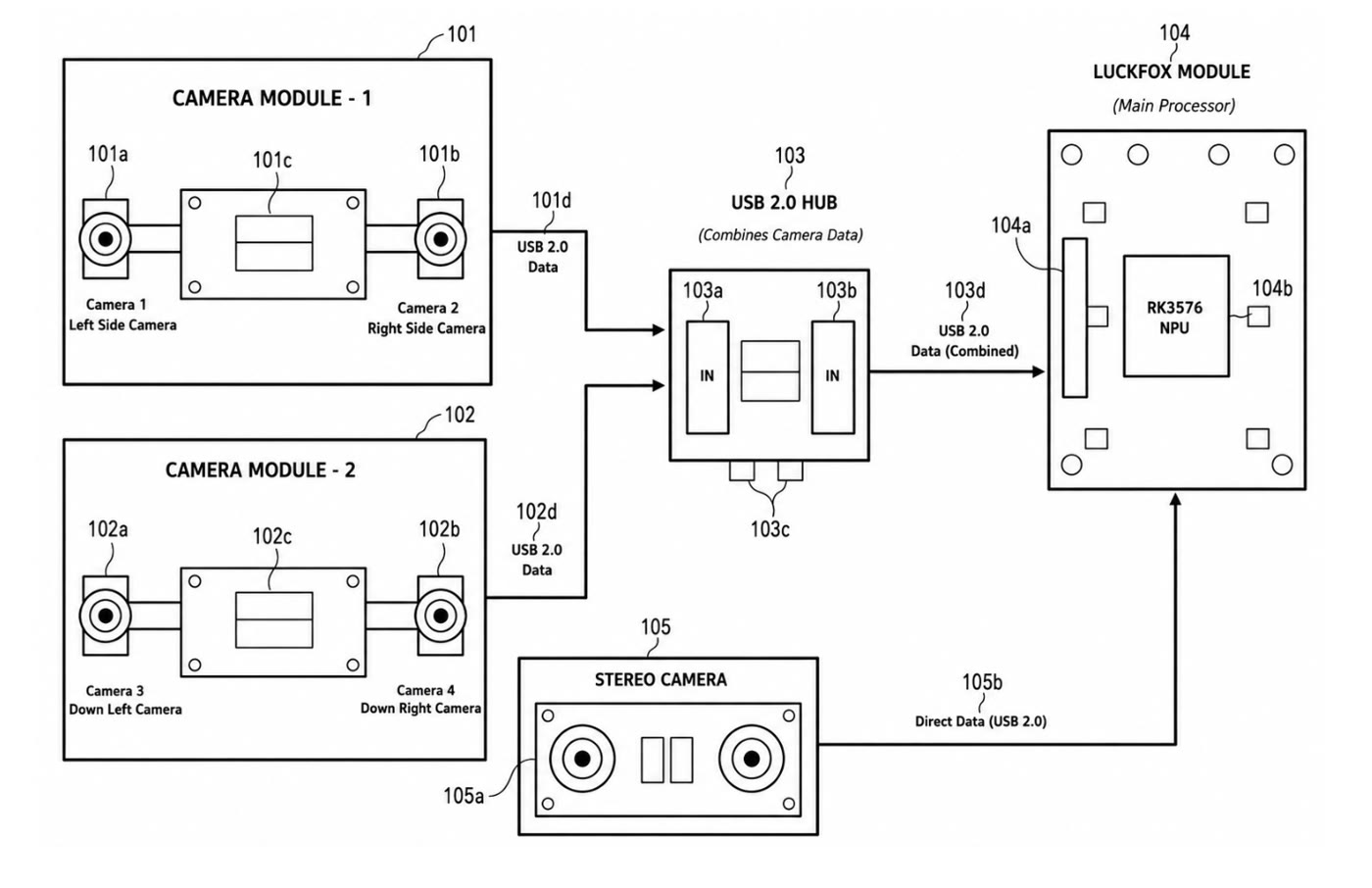
How the six streams reach the edge board, from our patent drawings.
The board encodes all six streams itself and writes them into one .mcap file, so nothing has to be lined up afterwards. Sessions are saved on the device and uploaded over Wi-Fi, and a live stereo feed can go to a phone while recording carries on.
XP-6, the six-camera rig, in a short promo video.
stereo over mono
Working with the data taught us how to use it. Taken one camera at a time, as mono images, it turned out to be practically useless for training. Taken as stereo pairs, it's far more useful: two views of the same scene give a model depth, which is what it needs to reach, grasp and place things accurately.
the data
The loop at the top is 30 seconds of one recording, straight from the dataset: the front stereo pair on the left, the side pair in the middle and the down pair on the right, all from the same instant. In this clip the wearer is working with parts at a bench.
Each .mcap file carries three H.265 video streams, one per stereo pair with both views side by side (the front pair at 3840 × 1200, the side and down pairs at 2560 × 960), a per-frame timestamp map for every stream and the IMU. In the recording behind the loop, the three streams start within a millisecond of each other.
what's next
I'm training a model on this data and deploying it in simulation. And 20 hours is just the beginning: we need to collect much more, across more people, places and tasks.
The rig is the subject of one of our provisional patent specifications at XP Robotics, from August 2026: synchronized wearable vision.